When all we see of the night sky are small, washed-out snippets, it's easy to forget that the stars have been marching above with the same rhythm they have for centuries. Let’s remind ourselves of that rhythm this month by taking the time to look up.
Orion, herald of the winter sky, is as gorgeous as ever! Orion is a great constellation for beginner skywatchers due to the striking brightness of the three stars that make up his belt. Once you’ve found the belt, two bright stars (Rigel below and Betelgeuse above) can help you find his limbs. If you’re looking for a challenge, follow the belt upwards in the sky to identify Aldebaran. Between that and Rigel, you now know the names of two of the six stars of the Winter Hexagon, the brightest asterism in the winter sky! See if you can use Aldebaran and Rigel to guide you towards the other four.

January 3rd
We have a bit of a boring month ahead, but that’s mostly because everything interesting is shoved into today, which is actually the most special day of the whole year. First of all, today Earth reaches the perihelion of its orbit. The vocabulary that describes orbits is a little bit different than the vocabulary used in elliptical geometry, since only one of the foci (the one occupied by the object being orbited) really matters to astronomers. Perihelion is the point on the ellipse where Earth is closest to the sun; more generally, we can use other roots to describe orbits around other objects, so you may occasionally hear words like “perigee” or “perijove” thrown around. Despite being 3 million miles closer to the sun at perihelion, nothing really changes about Earth’s local temperatures, which are mostly determined by axial tilt. However, long-term variations in our orbital eccentricity are one of the major drivers of glacial periods and climate changes. Cool!
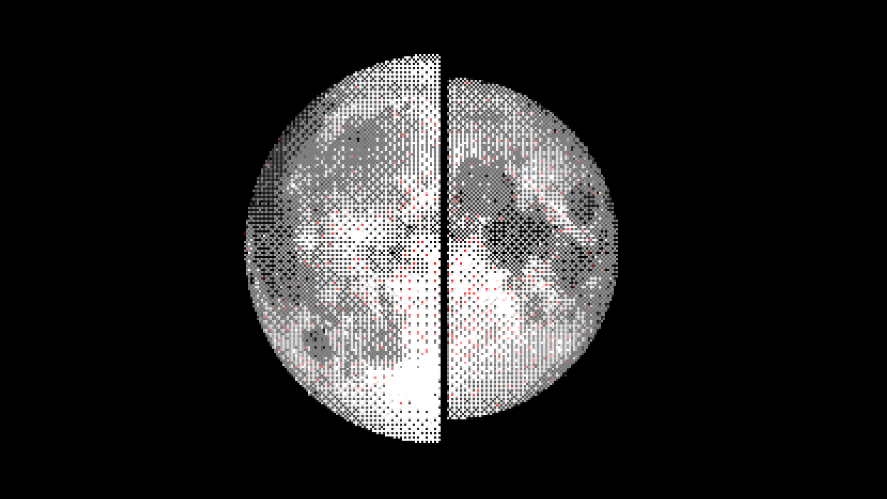
Anyway, back to the sky. The moon will reach its fullest phase early in the morning today, around 5:02am. Since it will have recently reached its perigee, a word that you can now guess the meaning of, it's also considered a supermoon! You just might be able to catch it if you’re up early for work, but it’ll be setting extremely low in the sky. Don’t be too sad if you miss it, though -- while the media loves to hype up supermoons, the difference between a supermoon and a typical full moon is imperceptible to the naked eye. In fact, the full moons of the last three months were supermoons too, and I bet you didn’t even notice. Full moons near perigee appear about 14% larger than those near apogee, but with nothing else in the sky to compare them to, the size difference is extremely subtle.
Since realistically none of us are waking up to see the morning’s full moon, we’re lucky that it rises again in the nighttime sky! I recommend looking out for it, since it’ll spend the night just a few degrees away from Jupiter. Definitely don’t miss this conjunction of the first and third brightest objects in the night sky! Unfortunately, all this brightness is definitely going to wash out the Quadrantids meteor shower, which peaks tonight and tomorrow. This time we can’t even blame it on NYC light pollution.
But most importantly: today is my birthday. The stars are literally aligning for me today -- perhaps a gift from the universe?
January 4th
Today at 7:18am is the latest sunrise we’ll have until next winter! For those of us who photosynthesize, getting out of bed will only get easier. Another piece of good news: the length of a day will increase by 46 minutes throughout January, and by the end of the month the sun will be setting after we get out of work.
January 8th
Remember the sunrise Manhattanhenge that none of us stayed up for last month? We have one more chance today at 7:18am! Only on equinoxes does the sun rise directly due east -- in winter, it begins to drift north of east, until reaching its most northern extent on the winter solstice. Now, on the other end of the solstice, the sunrise is drifting back southward, and in doing so it’ll again reach the precise direction which aligns it with Manhattan’s grid. The sunset drifts north on the opposite schedule, so the sunrise Manhattanhenge events surround the summer solstice.
January 10th
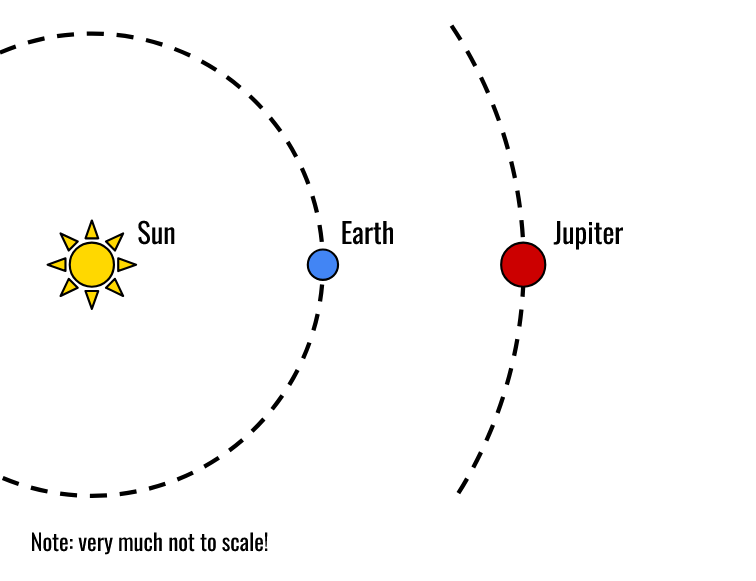
Today Jupiter is at opposition, when it aligns with Earth on one side of the sun to bring the two planets as close as they can possibly get. That also makes it extremely bright -- we won’t see Jupiter this bright for another 13 months, so it’s definitely worth going outside to check it out. If you have binoculars it’ll be a particularly impressive sight, and you may be able to catch a glimpse of its four brightest moons!
Challenge question: Typically we only think of the moon as having phases, but planets have phases too! Does Jupiter have the same phases as the moon? What percent of Jupiter’s surface appears illuminated when it’s at its minimum phase? (Assume circular orbits -- what are we, mathematicians? Also, Jupiter is five times as far from the sun as Earth.)
January 18th
There’s a new moon at 2:51pm today. Admittedly this is a really boring one, but it leads to some interesting questions to ponder: Why does it occur in the afternoon? Is it ever possible to “see” a new moon at night? Also, why isn’t every new moon a solar eclipse?
January 30th
There will be another conjunction between Jupiter and the nearly-full moon tonight, and conditions will be ideal. Look for them high in the southern sky, about five degrees apart.
Image credit: NASA/Goddard/Lunar Reconnaissance Orbiter, EarthSky.org