Winter is upon us. But do not fear – to those with an astronomer’s heart, the falling leaves are not a harbinger of seasonal depression, but a signal of the best season for stargazing!
Unfortunately, NYC might be one of the worst places in the world to see the night sky. Between tall buildings and a sky polluted with eight million peoples’ excess light, only the brightest stars are able to peek through the firmament. Luckily, winter brings long nights, bright stars, and some of the best constellations in the northern sky. This is a guide to the skylights of the next month, tailored for the worst stargazing spot in the world.
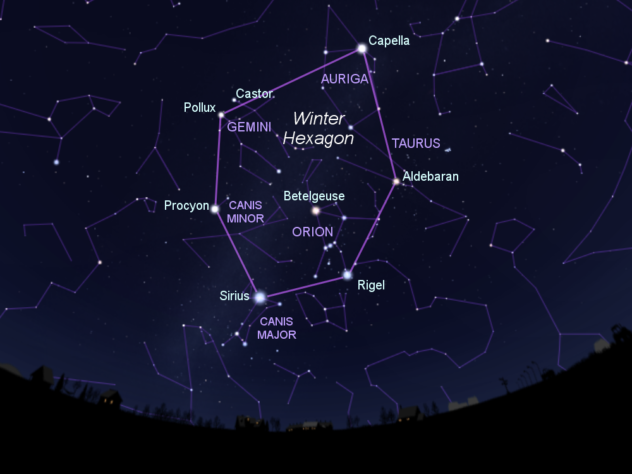
Let’s start with the constellations that’ll be visible all month. First, and most importantly, the Winter Hexagon is just beginning to grace the sky! These six stars are not a constellation but an asterism – whereas constellations are cultural, with well-defined boundaries and mythical stories attached to them, asterisms are obvious patterns of bright stars that have drawn in casual observers across cultures. The six stars of the Winter Hexagon are Aldebaran (a horn of Taurus the bull), Rigel (Orion’s right foot), Sirius (the brightest star in Canis Major), Procyon (its younger sibling in Canis Minor), Pollux (one of the Gemini twins), and Capella (no fun facts about this one, sorry). A veritable feast of bright stars!
Notice that the appearance of Rigel also means the appearance of Orion. Throughout the winter, this majestic constellation will reach higher into the sky and rise ever earlier. Keep an eye out for Orion’s scabbard, the three stars which dangle from his iconic belt -- the lowest of these is not a star, but a nebula about 24 light years across! It can be pretty tough to identify these stars with no other reference points, so I like to print out a star map before I head outside. Your phone can be useful, but bright light will ruin your night vision.
Now onto some remarkable astronomical events to keep an eye or two out for:
December 3rd
Tonight, a nearly full moon will pass in front of the Pleiades cluster in the eastern sky. Their closest approach will be around 11:45pm, but they’ll stay within a few degrees from each other the entire night. While most constellations are made up of stars that are very distant from each other, only appearing to be neighbors due to our perspective, the stars in the Pleiades all formed from the same cloud of gas. Astronomers recently discovered that these “Seven Sisters” actually have thousands more siblings that aren't visible to the naked eye, and the cluster's complicated dynamics has strewn these stars across the entire sky. The scientist behind the work, Andrew Boyle, said he’s now humbled by the sight of the Pleiades: “If I could actually see everything that’s there, it’d just be this arc of stars that would stretch from horizon to horizon.”
December 4th
It was close yesterday, but tonight the moon is actually full, reaching its brightest at 6:14pm. If you're in Manhattan, see if you can catch it peek between buildings around 10:30pm – more on that later…
December 5th
Today is one of the year's four Manhattanhenge events! Most of the sights in this newsletter we can only see despite New York, but this is one astronomical event that's only possible because of New York. The grid of Manhattan is tilted 29° from true north, and (by law!) that angle stays remarkably consistent across most of the island. It just so happens that four times per year, twice at sunrise and twice at sunset, the sun fits exactly into those corridors, transforming every block into a glimmering column of light. Catch a sunrise Manhattanhenge this morning at 7:04am.
December 8th
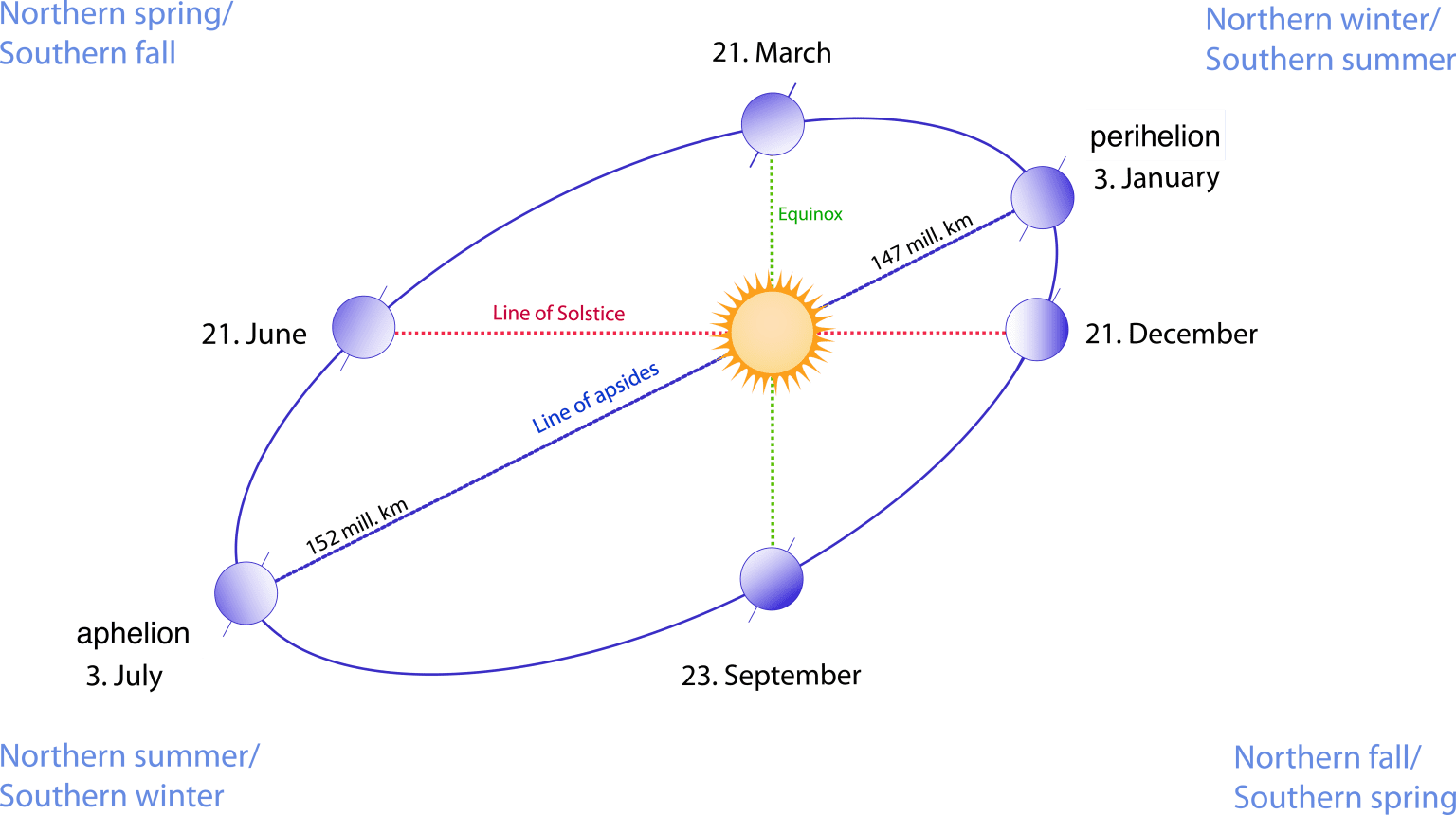
Today is the earliest sunset of the year for NYC, at about 4:28pm. Weirdly enough, this is two weeks before the winter solstice, the day that Earth’s axis is tilted away from the sun and the shortest day of the year. What’s up with that? It turns out that, while the rotation of the Earth is extremely regular, our orbit is slightly elliptical. When we’re closer to the sun (which is unintuitively true in the wintertime), we move faster through space, and this causes the sun to move faster across our sky. But the effect is small – throughout December, sunset only drifts by about 10 minutes.
December 12th-13th
These nights are the peak of the Geminids meteor shower, which many skywatchers agree is one of the best of the year. It starts nice and early, around 9pm, and on good nights you can expect about a meteor a minute! But take all this with a hefty grain of salt – we live in far from perfect conditions, and the show will be difficult to see unless you move to a darker, unobstructed sky. If you can find your way to Prospect Park or the Rockaways you’ll have a better chance than trying to view it from your fire escape. And I recommend you try! If you’ve never seen a meteor shower before, this is a perfect one to start with.
December 19th
After watching the moon wane to a sliver over the past few weeks, it finally disappears tonight at 8:43pm.
December 21st
Today is the winter solstice, the shortest day of the year. For us at 40 degrees north, that means a day that’s 9 hours, 15 minutes, and 16 seconds long. Yikes!
December 26th
Tonight, Saturn and the moon will be about five degrees apart in the southwestern sky. I like when the moon is in conjunction with a planet, because planets can be pretty tough to identify if you’re not an experienced skywatcher – a conjunction gives you a visual clue that what you’re seeing isn’t just a bright star. They’ll be neighbors for the entire night, but they’ll be setting, so try to catch them early. You may be able to see them Manhattanhenge around 6:30pm.
(Images ©Vito Technology, Sky & Telescope Magazine, Gothika)